Geography
Our Geography Curriculum
We understand at St. Mary’s that the study of geography equips young people with the knowledge and understanding to be informed citizens in the 21st century, providing them with the skills to pursue a range of careers.
(Royal Geographical Society October, 2023)
At St. Mary’s we are geographers. We believe that our role is to inspire every child to be passionate about Geography, whilst stimulating an interest in places, people and the environment. In EYFS, our children learn about the places around them, the earth, land and people. Throughout their school life, we help our children to make sense of the complex and dynamically changing world and how society, and the environment combine to bring about change. Our Geography curriculum explains where places are, how places and landscapes are formed, how people and their environment interact. We also explore how societies and our environments are interconnected. Within our Geography curriculum, we examine natural resources, their sustainable use and how it is all of our responsibilities to look after our world.
At St. Mary’s, we have an inclusive, broad, balanced curriculum that meets the statutory requirements outlined in the National Curriculum (2014) and Development Matters (2023) and it has been created based on the principles outlined in the OFSTED Research Review (2022).
Our Geography curriculum has the geographical concepts interwoven into each topic as researched in the Ofsted research review series: geography (2022). The Ofsted research review series: geography (2022) explains that:
‘Concepts are important in geography as they draw out the links between processes and ideas. To develop their understanding of each of these concepts, pupils need to learn the range of relevant knowledge and skills. It is from this knowledge and development of these skills that pupils gain a more abstract appreciation of the subject. Therefore, it is critical that the content of the curriculum is broken down into component parts (or chunks) that pupils can first comprehend in their own right, before combining different components to gain a fuller conceptual appreciation.’
At St. Mary's, we revisit and review within lessons, allowing active recall not only about the current topic but a series of topics and year groups, before introducing the new learning allowing children to know more, remember more and enables them this deeper understanding.
We understand the importance of the following concepts and our curriculum develops upon each of the following:
- Place
- Space
- Scale
- Interdependence
- Physical and human processes
- Environmental impact
- Sustainable development
- Cultural awareness
- Cultural diversity
At St. Mary’s we use the Kapow Primary Geography. It is a spiral curriculum, with essential knowledge and skills revisited with increasing complexity, allowing pupils to revise and build on their previous learning. Kapow Primary Geography covers all aspects of the National Curriculum and each unit has fieldwork opportunities embedded. Locational knowledge, in particular, will be reviewed in each unit to coincide with our belief that this will consolidate children’s understanding of key concepts, such as scale and place, in Geography.
Our Geography Curriculum:
- Provides a high-quality sequence of lessons, which develops children’s curiosity of the world that they live in.
- Specifies the substantive knowledge which needs to be taught. This includes place knowledge, locational knowledge, human and physical and environmental knowledge and field work skills. (National Curriculum, 2014)
- Allows children to develop disciplinary knowledge alongside and in between key geographical knowledge (substantive) in order for the children to develop the habits of thinking geographically.
- Integrates fieldwork into the curriculum, it occurs regularly and with purpose; it enables formal learning to occur outside of the classroom and immerses children in the key content of their learning, allowing them to build their disciplinary knowledge and think like a geographer.
- Allows children to be taught how to collect, present and analyse data from their wide range of fieldwork opportunities. In KS2, the children are taught how to draw conclusions from their findings.
- Ensures that map reading skills are progressive and children are given opportunities to interpret a range of maps. Children develop awareness to increase their understanding of how places connected.
- Provides many opportunities for active retrieval practice in order to know more and remember more.
- Teaches children to use and understand relevant geographical terms and vocabulary. We have vocabulary displayed while teaching and we ensure that it is explained to children.
- Uses a range of high - quality resources; online, books, visits and visitors in order for the children to learn more about the world that we live in.
Types of Knowledge in Geography
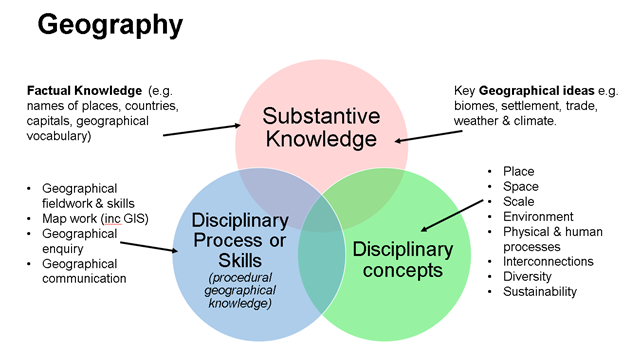
Substantive knowledge - this is the subject knowledge and explicit vocabulary used to learn about the content.
Disciplinary knowledge – this is the use of knowledge and how children become a little more expert as a geographer by “Thinking Geographically”. At St.Mary’s, we have identified the disciplinary knowledge as:
- Locational knowledge: - Builds own identity and develops their sense of place, develops pupils’ appreciation of distance and scale, helps pupils learn about the orientation of the world and how to navigate. Place: the significance of places and what they are like. Space: the significance of location and spatial distribution, and ways people organise and manage the spaces that we live in, Scale: the way that geographical phenomena and problems can be examined at different spatial levels.
- Place knowledge – How pupils connect to places and locations and identify themselves within the world e.g. - connection of location and physical and /or human geography processes with personal experience - no object of geographical study can be viewed in isolation
- Human and Physical Processes - explicit knowledge about geographical processes - for example, migration, glaciation, climate change, Environment: the significance of the environment in human life, and the important interrelationships between humans and the environment, Sustainability: the capacity of the environment to continue to support our lives and the lives of other living creatures into the future, Change: explaining geographical phenomena by investigating how they have developed over time
- Geographical skills and fieldwork – Procedural Knowledge - Using maps and globes and collecting first-hand evidence
SEND
Our Geography curriculum promotes and develops cultures and practices that include all learners. We aim to provide a sense of community and belonging and believe that educational inclusion is about equal opportunities for all learners, whatever their age, gender, ethnicity, impairment, attainment and background. When the curriculum needs adapting, to suit the needs of an individual, the appropriate modifications are made.
Assessment
Both summative and formative assessments are used regularly within geography. At St. Mary’s, the geography lead provides all teachers with the end points for each unit of work; in order to specifically identify what the pupils need to achieve. Staff use quizzing, questioning, discussions and pupil’s work books as part of assessment. Staff complete the end points at the end of a unit, collecting and entering the class data to Insight. Data is analysed by the geography lead. An end of year, overall judgement is then made based on the child’s progress in geography throughout the school year.